
For 630 stainless steel that has undergone solution treatment and aging (with a hardness of approximately 35 HRC),
the customer was using a surface grinder equipped with a monocrystalline corundum grinding wheel. During the grinding process, the workpiece exhibited a "sticky" behavior;
each dressing cycle removed only about 0.005 mm of material, and there was a significant discrepancy between the infeed setting and the actual material removal, indicating rapid wear of the monocrystalline corundum wheel.
To address these machining challenges, we—as a professional manufacturer of diamond and CBN grinding wheels—developed a CBN grinding wheel.
The operational procedure is as follows:
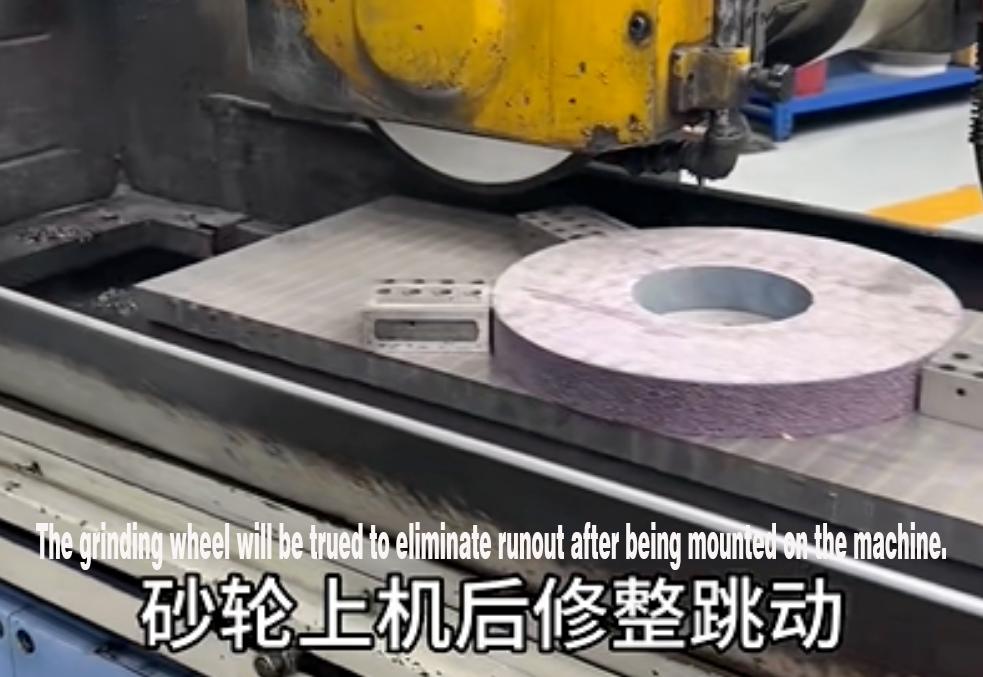
Once the grinding wheel is mounted on the machine, its outer diameter must be dressed to bring runout within standard limits due to bore-spindle fit and other assembly tolerances.
For this dressing process, a corundum grinding wheel is secured to the magnetic chuck. The dressing involves an infeed of 0.01 mm at each end of the stroke while maintaining a normal left-right oscillation;
the surface of the corundum wheel should be kept wet. Dressing is complete when the grinding sound becomes continuous and steady.
Grinding parameters are as follows:
Equipment: Hangzhou Machine Tool Works horizontal-spindle surface grinder with rectangular table
Grinding wheel specifications: 14A1 350×127×10×30×40T, 80#
Workpiece material: 630 stainless steel (solution-treated and aged); hardness approx. 35 HRC
Workpiece dimensions: Length 800 mm × Width 50 mm
Grinding parameters: Spindle speed: 1500 rpm; depth of cut per pass: 0.01 mm
Feed rate: 10 meters (10 passes/5 round trips) in 20 seconds
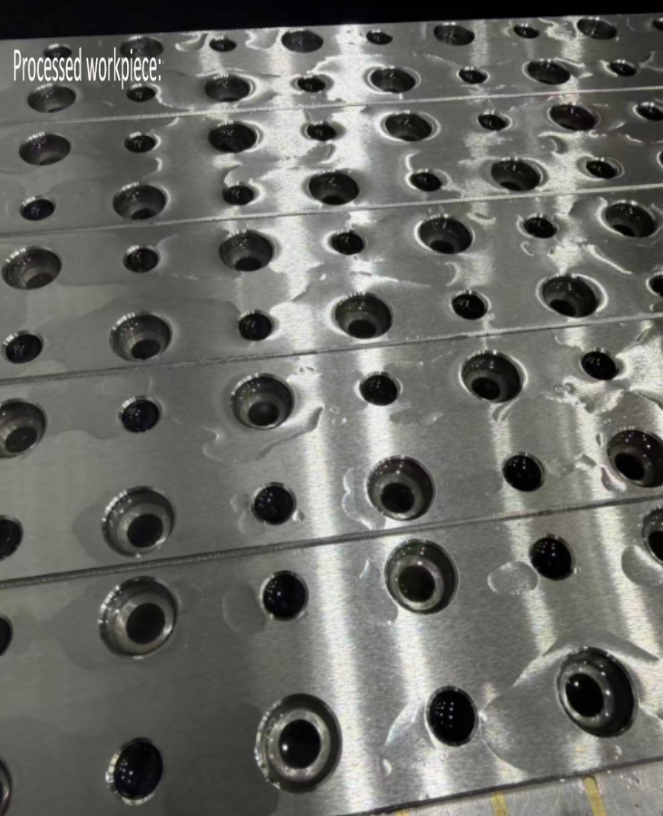
Processed workpiece:
The processed video is as follows:
Shijiazhuang Jinyunxiang Technology Co., Ltd. Data collection and organization: Dong Yingxiao